Attach rules to a PDF link or QR code instead of sending an uncontrolled attachment. Verify readers, limit opens, set an expiration, and choose how the document can be viewed.
No reader accountSet rules before sendingManage the same link later
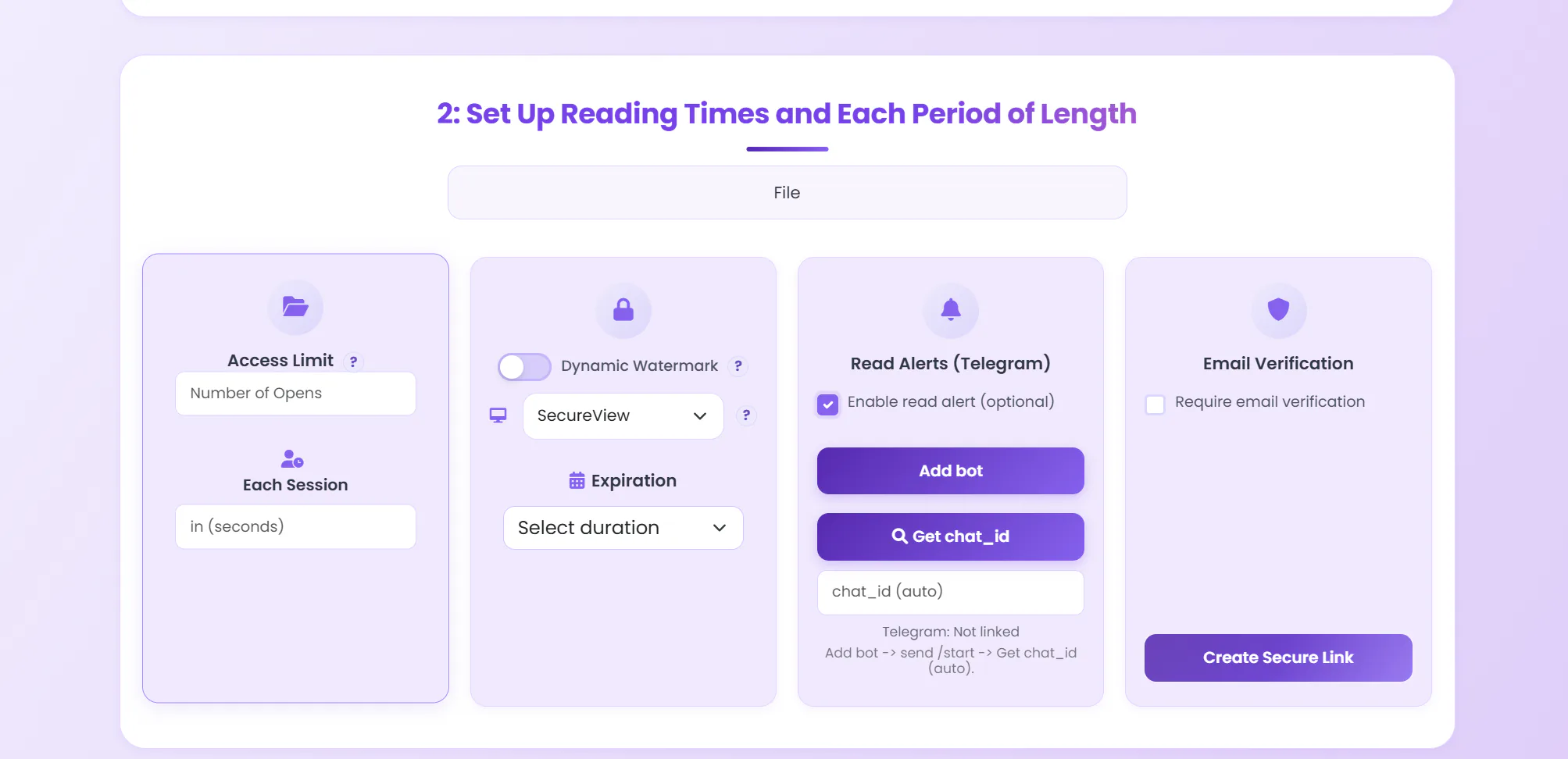
The actual sharing panel: access limit, session length, view mode, expiration, alerts, and email verification.
What it controls
Six rules you attach to one link.
You set the rules when you upload. The reader just opens the link or scans its QR code — every rule is checked before the document is displayed.
PDF access control
A controlled share is not a loose PDF attachment. It is a browser link with rules that are enforced on our side before the file is rendered, which is why they still apply after you have sent the link.
Who
Approved readers
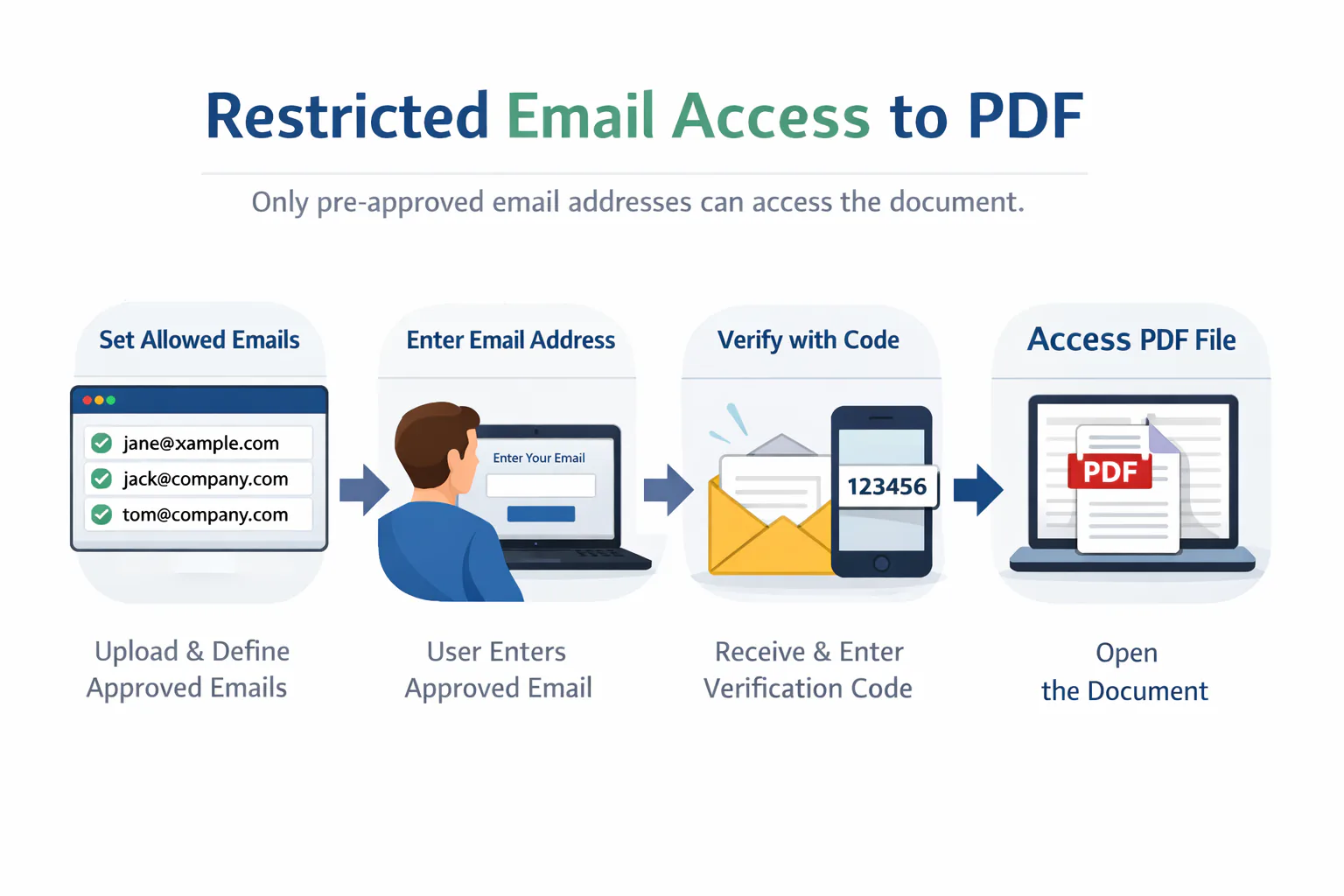
You list the exact email addresses that are allowed to open the document — up to 50 addresses, separated by commas. The reader types their address, receives a 6-digit code by email, and only after entering it does the PDF load. The code is valid for 5 minutes.
Matching is on the full address, so a whole domain cannot be allowed with one entry — every address has to be listed. Anyone who forwards the link to an address that is not on the list is stopped at this gate.
How many
Open limit
A total count of opens shared across all readers — not per person. The default is 10. Once the count is used up the link stops opening the document.
Setting a limit above 10,000 switches the link into unlimited mode. In that mode no access records are logged, and dynamic watermark and read alerts are unavailable.
How long
Session length and expiry
Two different clocks, and they are easy to confuse:
Each session is how long a single reading sitting may last. The presets are 5 minutes, 15 minutes (the default), 30 minutes, 1 hour, or a custom value in minutes. When the session runs out the reader has to open the link again, which consumes another open.
Expiration is when the whole share closes, regardless of how many opens are left. The presets are 1 hour, 3 hours, 24 hours (the default), 5 days, a custom number of days, or Never. After it expires the link no longer opens the document for anyone.
How
View mode
SecureView (recommended) — view-only in the browser, with no direct download, copy or print path. Unrestricted — anyone with the link reads freely.
A third option, Anti-Screenshot, requires the MaiPDF app: the app asks the operating system to protect its window so screenshots and recordings come back black. A browser cannot do this.
If it leaks
Dynamic watermark
Stamps the viewer’s own identity across every page as the document opens, so a screenshot can be matched back to whoever opened it. It does not stop a capture — it makes one traceable.
When it opens
Read alert
Sends you a Telegram notification the moment someone opens the document, so you know it landed without having to ask.
Like the dynamic watermark, read alerts are unavailable in unlimited mode (an access limit above 10,000).
After sharingReview access recordsChange the rulesReplace the PDFExpire or delete the share
Simple workflow
Set rules once. Manage them later.
01
Owner uploads
Upload the PDF and choose Online Sharing.
02
Owner sets rules
Configure limits, expiry, verification, and view mode.
03
Reader opens
Send the link or QR. The reader follows any enabled gate.
04
Owner manages
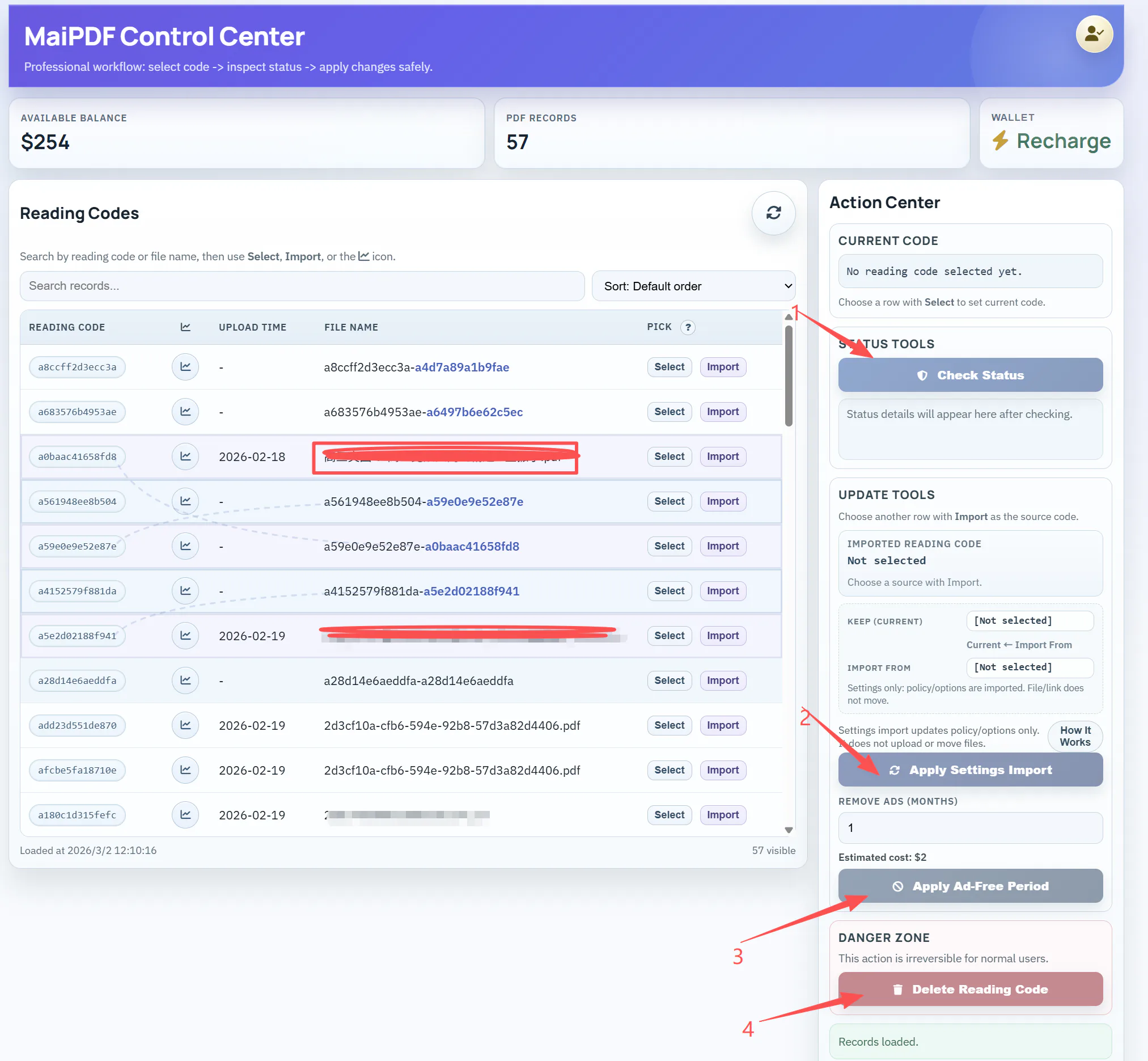
Inspect, update, replace or revoke — in Control Center if you were signed in, or with the modification code if you uploaded as a guest.
Practical examples
Use only the rules you need.
Proposal
Expiry + read alert
Keep the offer time-limited and know when the recipient opens it.
Internal draft
Email list + view mode
Allow approved colleagues to read without sending a clean attachment.
Updated document
Replace + same link
Correct or replace the PDF after sending without issuing a new URL.
Limited release
Open limit + expiry
Cap reading sessions and close the link automatically on a deadline.
What each side sees
Simple for readers, manageable for owners.
Readers never receive the management controls for the share.
Reader side. They enter their email address, receive a 6-digit code, type it in, and the PDF opens. They never see your rules, your other shares, or how many opens are left.Owner side (signed in). Control Center lists every share you created. Select a reading code to check its status and remaining opens, change the session length, import settings from another PDF, replace the file, or delete the share.
Before you upload
Hard limits worth knowing.
These are enforced by the uploader itself, so it is quicker to know them up front.
PDF onlyThe uploader accepts .pdf files.
80 MB per fileAnything larger is rejected with “Please upload PDF files within 80 MB”.
Lower-case extensionA file ending in .PDF is refused — rename it to .pdf first.
No # in the file nameRemove it before uploading, or the file will not be accepted.
Expiry uses your time zoneThe uploader detects your local time zone and shows the matching UTC time, so a deadline means what you expect.
Managing a share afterwards
Two ways to change a share, depending on how you created it.
MaiPDF has two management paths because it supports sharing with or without an account. Which one you use was decided at upload time.
Why there are two paths at all
MaiPDF began without any login system: every upload was anonymous, and that guest route was never removed. Sharing a PDF without creating an account is still fully supported, so the product has to answer one question for anonymous uploads — if there is no account, how does the system know that you are the person who uploaded this file?
The answer is the modification code. It is issued once, at upload, and it is the proof of ownership for a guest share. A signed-in account proves ownership on its own, so it does not need one. That single difference is what produces the two paths below.
When you upload as a guest you receive two codes, and they do different jobs:
Reading code — this is what your recipients use to open the document. It travels inside the share link.
Modification code — this stays with you. It is the only proof that the share is yours.
To replace the file, that page asks for four values: the current link or reading code, its modification code, the new PDF's link or reading code, and the new PDF's modification code. In other words, you upload the replacement PDF first to obtain its pair of codes, then point the original share at it. The original share URL stays the same, so recipients do not need a new link.
Keep the modification code. There is no account and no password reset behind a guest share. If the modification code is lost, the share can no longer be changed or replaced.
The reverse is also worth knowing: a closed link is not a dead end, a lost code is. Replacement does not require the link to still be working, so a share whose opens ran out, whose deadline passed, or that was set to zero can still be repointed at a new PDF — keeping the same URL and QR code — as long as you hold both codes.
Your account is the proof of ownership, so no modification code is involved. Every share you have created is listed in one place. Select a reading code, then:
Check Status — see the current rules and remaining opens for that share.
Each Session — change how long a single reading session may last.
Settings Import — copy the rule set from one of your other PDFs onto this one.
Ad-free period — apply an ad-free window to the share.
Delete — close the share so the link stops opening the document.
Replacing the file is also done from here, without needing to track codes yourself.
Protection boundary: browser controls reduce casual saving and forwarding, but a browser cannot block operating-system screenshots — shortcuts such as Win + Shift + S or PrtScn are handled before the page is ever aware of them. Nor can any tool stop a camera pointed at the screen. Use a dynamic watermark to make a leak traceable, or App DRM if the capture itself has to be blocked.
FAQ
Before you share.
Can I change rules after sharing?
Yes, and the same link keeps working with the new settings. How you do it depends on how you uploaded: if you were signed in, open Control Center, and select the reading code. Session length is the one rule you can edit directly there; the open limit, expiry, allowlist, view mode and watermark are fixed at upload and change only by replacing the share. If you uploaded as a guest, use the modification code you received at upload, at maipdf.com/pdf/replace-file.html.
Why are there two different ways to modify a share?
Because MaiPDF supports sharing without an account. For a signed-in user, the account itself proves the share belongs to you. For an anonymous guest upload there is no account, so something else has to prove ownership — that is the modification code, issued once at upload. Both paths change the same share; only the proof of ownership differs.
What happens if I lose the modification code?
For a guest share, the modification code is the only proof of ownership: there is no account and no password reset behind it, so the share can no longer be changed, replaced or deleted. Save it when you upload. Signed-in users do not have this risk, because everything is listed in Control Center.
How do I replace the PDF file itself as a guest?
Upload the replacement PDF first, so that it gets its own reading code and modification code. Then go to maipdf.com/pdf/replace-file.html and enter four values: the current link or reading code, its modification code, the new PDF's link or reading code, and the new PDF's modification code. The original share URL does not change, so your recipients keep using the link they already have.
Do readers need an account?
No. They open the link directly, or verify an approved email if you enabled that gate.
Does a QR code use the same rules?
Yes. The QR code points to the same controlled URL.
What if I need stronger device protection?
Use App DRM for an encrypted file, device authorization, and a controlled app reader.
Can I put a password on the link?
MaiPDF has no passcode field — there is nowhere to set a password on a share. What does work is the PDF’s own password: if the file you upload was already encrypted with Acrobat, WPS, Word or another tool, the reader shows the standard “Enter the password to open this PDF file” prompt, and the reader must type that original password before any page renders. MaiPDF neither knows nor stores it — it lives in the file. This behaves identically on maipdf.com and maipdf.cn, since both use the same viewer. It is a workable way to split the link and the secret across two channels, but the password can be forwarded on, and the records only show that someone opened the file — not who passed the password along. To tie an open to a person, use email verification instead: the verified address goes into the record. An encrypted PDF is still subject to the open limit, expiry, watermark and records; the file’s password sits on top of those rules, not instead of them.
Ready to set rules on a PDF?
Upload once, share by link or QR, and keep control after sending.
 MaiPDF